Hydroponic Grow Room Climate Control: Precision HVAC for Urban Farming
How do you keep 9,500 watts of LED grow lights from cooking your crops? That was the challenge when a Sussex-based urban farming business asked us to design climate control for their commercial hydroponic facility. The answer involved precision ducted air conditioning, closed-loop CO2 injection, and some creative engineering.
Precision Climate Control for Commercial Hydroponics
Growing fresh herbs and salad leaves in controlled indoor environments demands precise temperature, humidity, and atmospheric conditions that go far beyond standard commercial air conditioning. Get it wrong, and you lose entire crops. Get it right, and you can achieve yields 40% higher than traditional growing.
The UK vertical farming market is experiencing remarkable growth, projected to reach £14.7 billion by 2035 according to Precedence Research. With climate change disrupting traditional agriculture and increasing demand for locally-grown produce, controlled environment agriculture (CEA) is becoming essential for British food security.
This project gave us the opportunity to design and install a complete commercial climate control system optimised for plant growth rather than human comfort.
Quick Facts:
- Location: Sussex commercial unit
- Challenge: 9,500W heat from LED grow lights across 3 cabinets
- Solution: Mitsubishi Heavy Industries ducted AC with CO2 recirculation
- Result: Stable 18°C, 50-65% humidity, elevated CO2 levels maintained
The Project: Three Custom Grow Cabinets
The client operates an urban farming business growing premium herbs and salad leaves using hydroponic systems with LED grow lights. They required climate control for three purpose-built insulated wooden cabinets, each housing multiple tiers of hydroponic growing racks.
Cabinet Specifications
Two smaller cabinets (1.16m wide each):
- Six-tier hydroponic rack systems
- LED grow lights producing 2,376W heat output per cabinet
- Target growing area for herbs and microgreens
One larger cabinet (2m wide):
- Multi-tier hydroponic system
- LED grow lights producing 4,752W heat output
- Increased production capacity
The insulated construction helps maintain stable conditions, but the significant heat output from LED grow lights creates a substantial cooling challenge that must be precisely managed.
Understanding Grow Room Climate Requirements
Commercial hydroponics operates differently from standard HVAC applications. Plants have specific environmental needs that directly impact growth rates, crop quality, and ultimately business profitability.
Temperature Control
Unlike office or retail cooling where comfort is the goal, grow room temperature directly affects plant metabolism. The client required:
- Target temperature: 18°C for optimal growth
- Tight tolerance: Fluctuations can stress plants and affect yield
- Day/night differential: Plants benefit from slightly lower temperatures during dark periods
LED grow lights are more efficient than traditional HPS lighting, but they still generate significant heat. Every watt of lighting produces approximately 3.41 BTUs of heat that must be removed from the growing environment.
Humidity Management
Humidity control is critical in hydroponic environments:
- Target range: 50-65% relative humidity
- Too low: Increased spider mite risk, plant stress, reduced transpiration
- Too high: Powdery mildew, root rot, bacterial growth
The relationship between temperature and humidity is complex. When temperature increases by 10°C, the moisture-holding capacity of air roughly doubles. This means cooling and dehumidification must work together as an integrated system.
Related: Understanding ventilation and humidity control
CO2 Enrichment: The Growth Multiplier
This is where the project became particularly interesting. The client wanted a closed-loop CO2 injection system to maximise plant growth.
Atmospheric CO2 levels sit around 400-420 parts per million (ppm). Research shows that increasing CO2 to 1,000-1,500 ppm can increase crop yields by 40-100% for C3 plants like lettuce and herbs. This accelerated photosynthesis means faster growth cycles and higher productivity.
However, CO2 enrichment only works effectively when other conditions are optimised:
- Adequate light intensity (the LED systems provide this)
- Correct temperature range
- Appropriate humidity levels
- Proper nutrient delivery (handled by the hydroponic system)
Above 2,000 ppm, CO2 becomes toxic to plants, and above 4,000 ppm it’s dangerous for humans. Precise control is essential.
The Climate Control Solution
After surveying the facility and calculating the thermal loads, we designed a comprehensive system using Mitsubishi Heavy Industries ducted units.
Cooling System Specification
For the two smaller cabinets:
- 2x Mitsubishi Heavy Industries SRR50ZS-W ducted indoor units
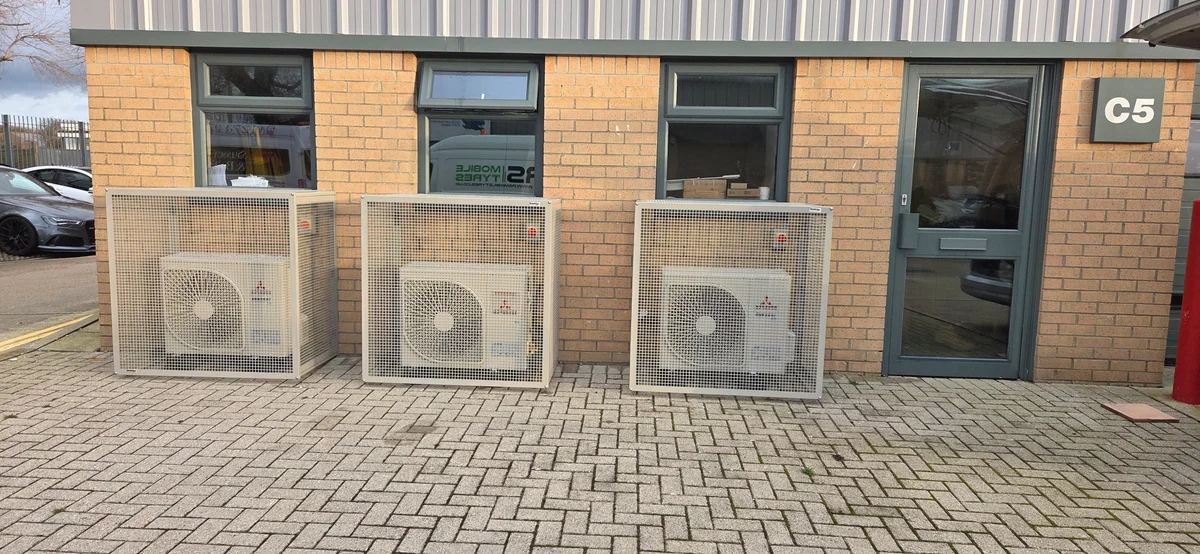
- Paired with SRC40ZSX-W outdoor condensers
- 4.1kW cooling capacity per system
- R32 refrigerant for environmental efficiency
The SRR50ZS-W features an ultra-slim 200mm profile, ideal for installations where ceiling space is limited. The built-in drain pump handles condensate removal, which is particularly important in high-humidity growing environments.
For the larger cabinet:
- 1x Mitsubishi Heavy Industries FDC71VNP-W system
- 7.1kW cooling capacity
- Sized for the increased heat load from larger LED arrays
Why Ducted Systems?
We specified ducted rather than wall-mounted units for several reasons:
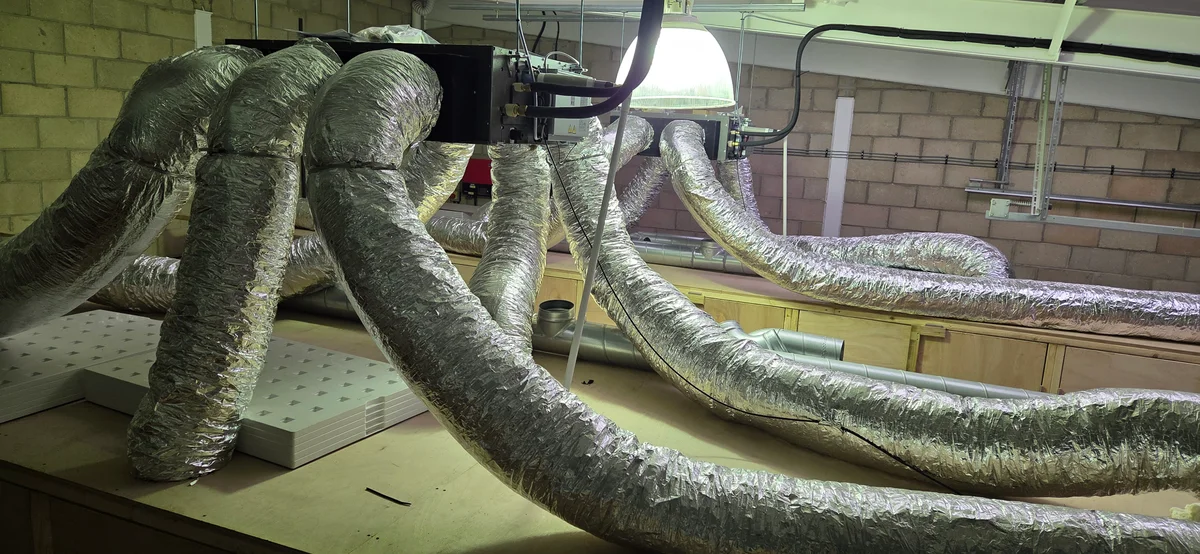
- Even air distribution: Ducted systems deliver conditioned air evenly across the growing area, preventing hot spots that could stress plants
- Integration with CO2 system: The ductwork integrates with the CO2 recirculation system
- Reduced direct airflow: Plants don’t benefit from direct cold air blowing on them; gentle, even distribution is better
- Flexibility: Duct positioning can be optimised for the specific cabinet layout
CO2 Recirculation System
The CO2 injection system required careful integration with the climate control:
Components installed:
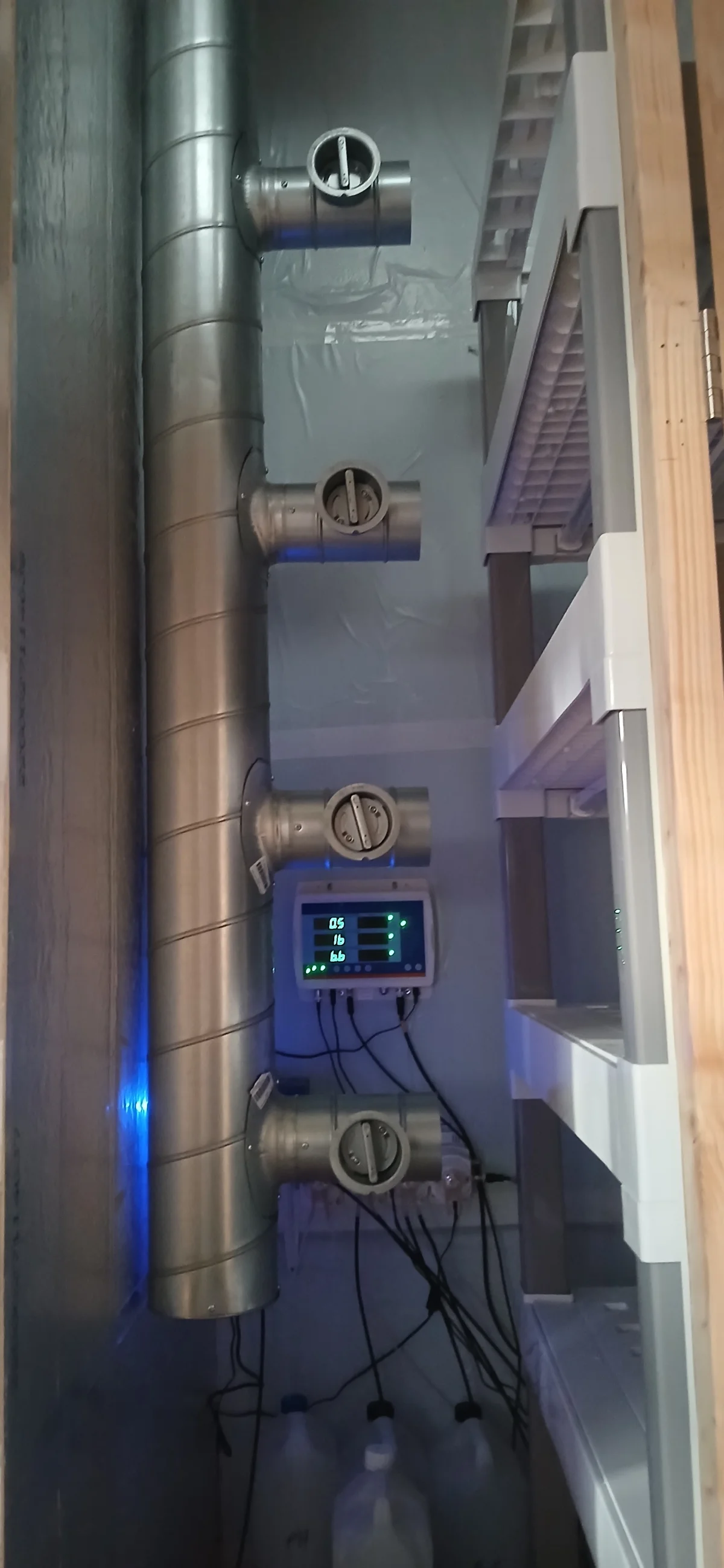
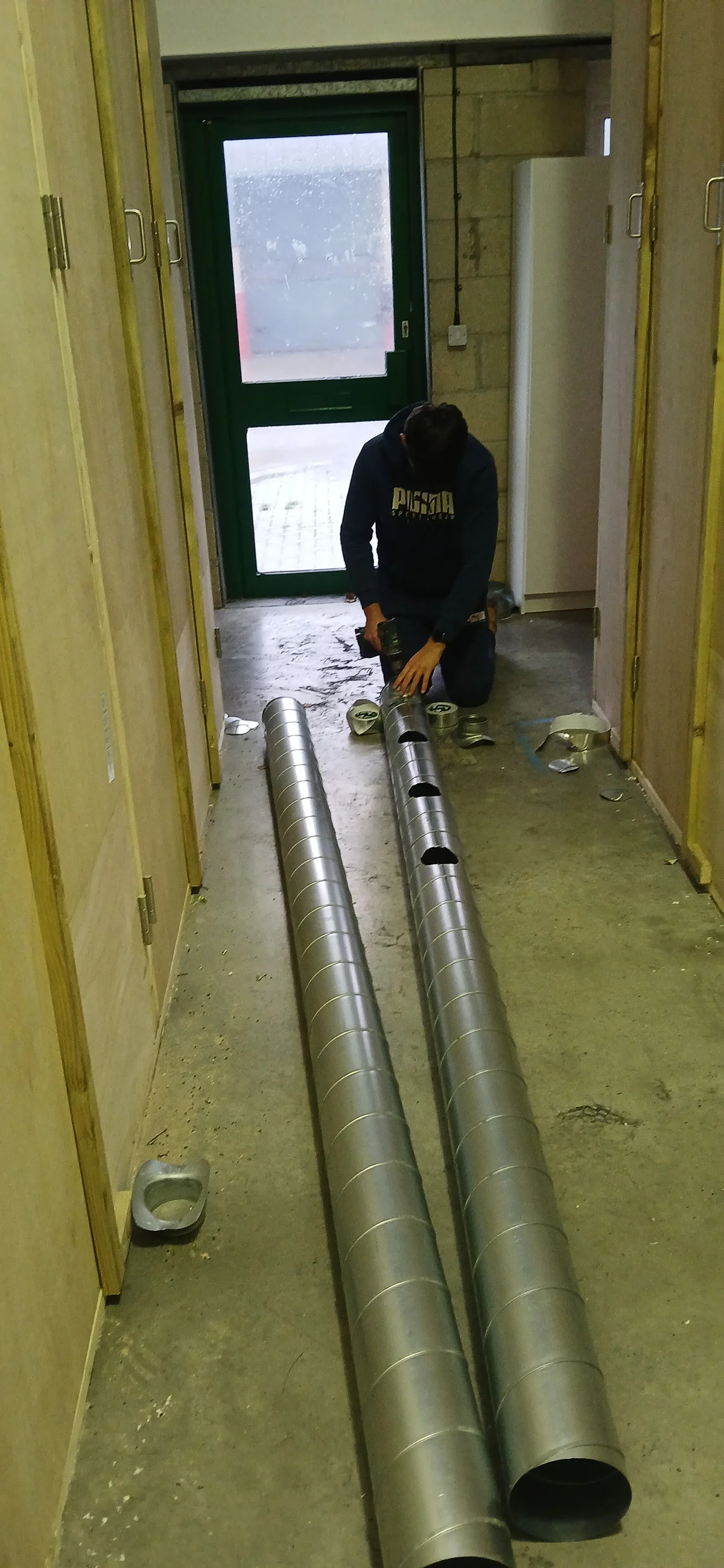
- Solid spiral ducting for CO2 distribution
- Control dampers for balanced airflow across growing tiers
- CO2 injection points integrated into the air handling system
- Monitoring sensors for safety and optimisation
The system operates as a closed loop. Rather than exhausting air (and losing expensive CO2), we recirculate and treat the air within each cabinet. The AC systems handle temperature and contribute to humidity control, while the CO2 injection maintains enriched atmospheric conditions.
Control dampers at strategic points allow balancing airflow between growing levels, ensuring each tier receives appropriate CO2 concentration and temperature control.
Wi-Fi Integration and Smart Controls
Modern grow operations demand sophisticated monitoring and control. We installed Wi-Fi controllers on each system, enabling:
- Remote monitoring: Check temperatures and system status from anywhere
- Home automation integration: The client uses Home Assistant for centralised facility management
- Alerts: Immediate notification if conditions drift outside parameters
- Data logging: Track environmental conditions over time for crop optimisation
The ability to monitor and adjust conditions remotely is invaluable for commercial operations where overnight temperature excursions could damage valuable crops.
Technical Challenges and Solutions
Heat Load Calculations
LED grow lights are often marketed as “cool running,” but this is relative to older HPS systems. The 2,376W per small cabinet and 4,752W for the large cabinet represent substantial heat loads in enclosed, insulated spaces.
We calculated:
- Small cabinets: ~8,100 BTUs heat generation requiring removal
- Large cabinet: ~16,200 BTUs heat generation
The AC systems were sized with headroom for peak summer conditions and to handle the continuous operation these facilities require.
Maintaining CO2 Levels During Cooling
Traditional cooling exhausts heat to outside air. In a CO2-enriched environment, this would waste expensive CO2 gas. Our closed-loop approach:
- Maintains elevated CO2 levels within each cabinet
- Recirculates air through the ducted system
- Cools and conditions without atmospheric exchange
- Only requires minimal fresh air for safety
Power Management
The client raised concerns about power cycling affecting the AC systems. Some equipment can fault if power is interrupted multiple times in quick succession. We configured the systems to handle:
- Lighting schedules that cycle power
- Potential power fluctuations in the industrial unit
- Integration with the overall facility power management
The Growing Importance of Controlled Environment Agriculture
This project reflects broader trends in UK agriculture. Indoor vertical farming addresses several pressing challenges:
Food security: With climate change disrupting traditional growing seasons and Brexit affecting imports, locally-grown produce becomes strategically important.
Reduced food miles: Urban farms supply local markets and restaurants with fresh produce that hasn’t travelled thousands of miles. Sussex restaurants and farm shops increasingly source from local vertical farms.
Year-round production: Unlike seasonal outdoor growing, controlled environments produce consistently throughout the year.
Water efficiency: Hydroponic systems use up to 90% less water than traditional agriculture. Combined with heat recovery ventilation, energy consumption can be further reduced.
Pesticide-free production: Sealed growing environments eliminate most pest pressures, enabling truly clean production.
The challenge has always been energy costs, particularly for cooling and lighting. Efficient climate control systems like those we installed help make these operations economically viable.
Project Completion and Results
The installation was completed in phases, with the cooling systems commissioned first, followed by the CO2 injection integration. The client reports:
- Stable temperatures: Consistent 18°C maintained despite LED heat output
- Humidity control: Operating within the 50-65% target range
- Successful CO2 enrichment: Elevated levels maintained without loss through exhaust
- Quiet operation: Important for a working facility
- Remote access: Full monitoring through Home Assistant integration
The combination of precision climate control and CO2 enrichment has enabled optimised growing conditions that wouldn’t be possible with standard HVAC approaches.
Specialist Applications Require Specialist Knowledge
This project demonstrates why commercial growing operations need HVAC contractors who understand the specific requirements of controlled environment agriculture. Standard “cool the space” approaches don’t address:
- The interaction between temperature and humidity
- CO2 retention requirements
- Even air distribution across growing tiers
- Integration with automated monitoring systems
- The precision tolerances plants require versus human comfort
At Ernest Air Cooling, we’ve developed expertise in these specialist applications through projects across Sussex and the South East. Whether you’re operating a commercial grow facility, research laboratory, or other environment with precise climate requirements, we can design systems that deliver the conditions you need.
See also: Commercial air conditioning installations
Project Gallery
Frequently Asked Questions
What temperature should a hydroponic grow room be?
Most leafy greens and herbs grow optimally between 18-24°C, with 18°C often preferred for slower, quality growth. Temperature requirements vary by crop; consult with your agronomist for specific varieties. Consistent temperatures matter more than hitting an exact number.
How much cooling do LED grow lights need?
Calculate approximately 3.41 BTUs per watt of LED lighting. A 2,400W LED system generates roughly 8,200 BTUs of heat requiring removal. In enclosed, insulated grow cabinets, this heat cannot dissipate naturally and must be actively cooled.
Can standard air conditioning work in grow rooms?
Standard AC can cool grow rooms, but ducted systems offer better air distribution and integration with CO2 systems. Wall-mounted units create uneven temperatures and direct airflow that can stress plants. Purpose-designed installations optimise for plant requirements rather than human comfort.
What humidity level do hydroponic plants need?
Most crops prefer 50-65% relative humidity, though this varies by growth stage. Seedlings often need higher humidity (60-70%), while flowering/fruiting stages may require lower levels. Proper climate control allows adjustment through different growth phases.
Is CO2 injection worth the investment?
For commercial operations, CO2 enrichment to 1,000-1,500 ppm can increase yields by 40% or more for leafy greens and herbs. The investment in CO2 systems and sealed environments is typically recovered through increased productivity within 1-2 growing cycles.
How do you prevent CO2 waste in grow rooms?
Closed-loop climate control systems recirculate air within the growing environment rather than exhausting to atmosphere. This maintains elevated CO2 levels while still controlling temperature and humidity. Proper sealing and controlled air handling are essential.
Planning a Commercial Growing Facility?
Climate control is fundamental to successful controlled environment agriculture. We design and install HVAC systems optimised for hydroponic, vertical farming, and indoor growing applications.
From initial heat load calculations through to CO2 integration and smart monitoring, we deliver complete climate solutions for commercial growers.